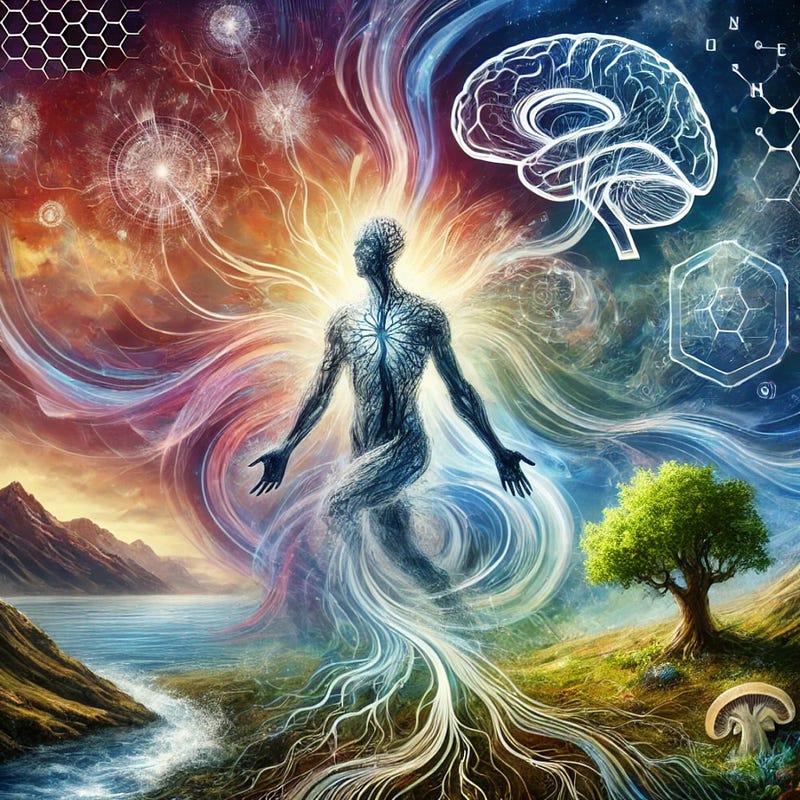
In our quest to understand the human experience, two questions have persisted throughout history: What is the relationship between the mind and body? and Who am I? Traditional theories have offered various answers, often viewing the mind and body as separate entities or the self as a static being. But what if we approached these questions from a new angle — one that sees consciousness and identity as dynamic, emergent properties arising from the intricate interplay between our brains, bodies, and environments?
Welcome to the theory of Holistic Emergent Identity. This fresh perspective invites us to see ourselves not as isolated individuals but as ever-evolving beings shaped by continuous interactions within and around us.
Emergent Consciousness: The Symphony of the Mind
Imagine an orchestra where each musician plays a vital role, but the true magic happens when they perform together. Similarly, emergent consciousness suggests that while neurons and brain regions have specific functions, consciousness arises from their complex interactions. It’s not about individual parts but how they connect and communicate, creating something greater than the sum of their parts.
This view shifts our understanding from a compartmentalized brain to a holistic system where consciousness is a dynamic process. It’s an ongoing symphony, constantly adapting and evolving as we engage with the world.
Dynamic Interconnectedness: We Are Not Alone
Our minds and bodies are in a perpetual dance with the environment. From the cultural norms we absorb to the personal relationships we nurture, external factors profoundly influence our internal world. Holistic Emergent Identity emphasizes this dynamic interconnectedness, proposing that our identities are co-created through these interactions.
Think about how different you feel when you’re at work versus with close friends. Each environment brings out different aspects of your identity. This theory acknowledges that who we are is fluid, shaped by the ever-changing contexts of our lives.
Neuroplasticity and the Adaptive Self
One of the most exciting aspects of this theory is its alignment with neuroplasticity — the brain’s ability to reorganize itself by forming new neural connections. Every experience, every challenge, every relationship can physically alter our brain structure, influencing our thoughts, emotions, and behaviors.
This means our identities are not fixed but adaptable. We are continuously reconstructing ourselves, learning, and growing. The self is not a static portrait but a dynamic canvas, constantly being painted with the colors of our experiences.
The Relational Self: “Who Am I?” in Context
When we ask, “Who am I?”, Holistic Emergent Identity encourages us to see the self as a process rather than a static entity. Our identities are deeply relational, emerging from our connections with others and the world.
This perspective allows for the multiplicity of selves — we can be different things to different people and in different contexts, without losing the core of who we are. It’s an empowering notion that embraces the complexity and richness of human identity.
Embodied Mindfulness: Integrating Body and Mind
In a world that often feels fragmented, practices like mindfulness meditation offer a pathway to embodied mindfulness — a state of being where we are fully present in our bodies and minds. By paying attention to our sensations, thoughts, and emotions without judgment, we foster a deeper connection between our physical and mental selves.
This integration enhances our awareness of the mind-body connection, allowing us to experience life more fully and authentically. It’s a practical application of the theory, demonstrating how understanding our holistic nature can lead to personal growth and well-being.
Bridging Disciplines: The Strength of Integration
Holistic Emergent Identity isn’t just a philosophical idea; it’s supported by findings across various fields:
• Neuroscience shows how social interactions can reshape neural pathways, reinforcing the impact of our environment on our brain.
• Psychology highlights how cultural and social contexts influence identity formation.
• Philosophy, especially Eastern traditions, has long emphasized interconnectedness and the fluid nature of the self.
By integrating these disciplines, the theory provides a comprehensive framework for understanding the mind-body relationship and the self.
Practical Implications: Beyond Theory
Understanding ourselves as holistic, emergent beings has profound implications:
• Mental Health: Holistic approaches can lead to more effective treatments, acknowledging the interplay of mind, body, and environment.
• Education: Recognizing that identity is emergent can foster learning environments that support personal growth and adaptability.
• Social Relationships: Appreciating the co-created nature of identity can enhance empathy and improve interpersonal dynamics.
Conclusion
The theory of Holistic Emergent Identity offers a transformative perspective on some of life’s most profound questions. By viewing consciousness and identity as emergent properties arising from the dynamic interplay of brain, body, and environment, we embrace a more nuanced and empowering understanding of ourselves.
This holistic approach not only bridges gaps between disciplines but also provides practical pathways for personal development and social harmony. It invites us to see ourselves as ever-evolving beings, intricately connected to the world around us.
Reflective Questions
As you ponder this theory, consider:
• How have your experiences and relationships shaped who you are today?
• In what ways do you adapt your identity in different social or cultural contexts?
• How might embracing a holistic, emergent view of yourself enhance your personal growth and well-being?
Join the Conversation
We are all participants in the ongoing symphony of human experience. Share your thoughts and stories about how your mind, body, and environment have interacted to shape your journey. Let’s explore together the rich tapestry of our holistic emergent identities.
 One Way Life
Leave a comment